Short answer
Most kidney transplant patients go home in about 1 to 2 weeks. The first 3 months need frequent blood tests and close care against infection. Anti-rejection medicines must be taken on time every day for as long as the kidney works. Most people return to normal daily life and office work within 2 to 3 months.
A successful kidney transplant ends dialysis, but the new kidney needs care every day to keep working for many years. This guide covers what to expect after the operation, from the first week to the years ahead. It is based on the routine followed by the transplant team of Dr. Aditya P.S. Sengar at Precision Urology Hospital, Lucknow. Your own team's advice always comes first, because every patient is different.
The first days in hospital
- The new kidney often starts making urine within hours, though in some patients it takes a few days.
- A urine catheter stays for a few days, and a small internal tube (DJ stent) protects the join between the kidney and the bladder.
- Blood tests are done every day to follow creatinine and the level of anti-rejection medicine.
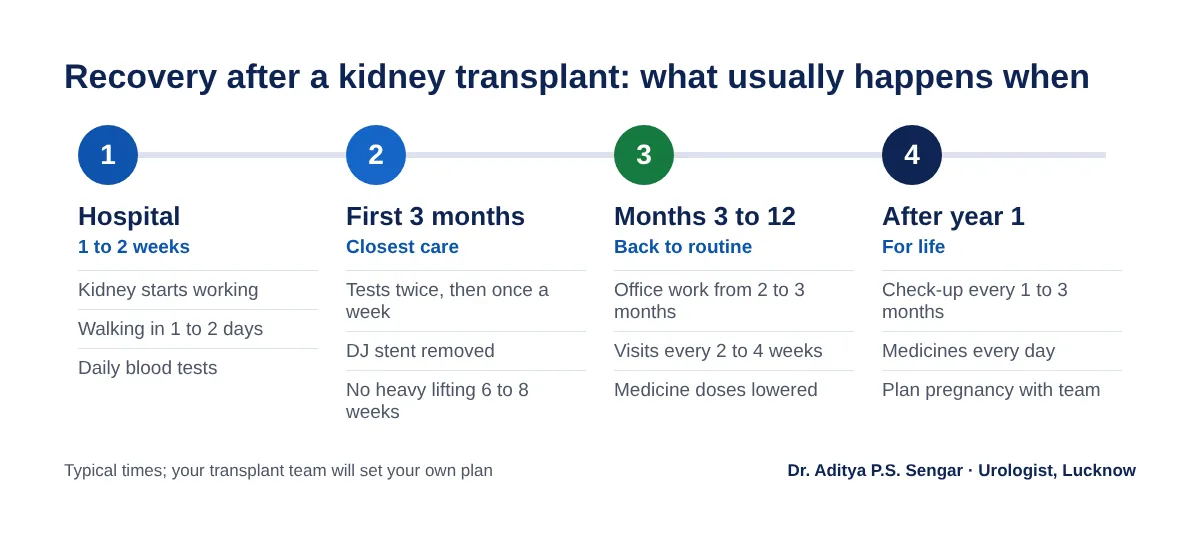
- Most patients walk on the first or second day and go home in about 1 to 2 weeks.
The first 3 months at home
This is the period when rejection and infection are most likely, so the routine is strict:
- Clinic visits and blood tests are frequent at first, usually twice a week, then weekly, then less often as the kidney settles.
- The DJ stent is usually removed in a short day procedure a few weeks after surgery.
- Keep a daily record of weight, blood pressure, temperature and urine output, and bring it to each visit.
- Avoid heavy lifting for about 6 to 8 weeks so the wound heals well.
- Walk every day. Start with short walks and increase slowly.
Anti-rejection medicines
Your immune system sees the new kidney as foreign. Anti-rejection (immunosuppressant) medicines such as tacrolimus, mycophenolate and steroids stop it from attacking the kidney.
- Take them at the same times every day, usually 12 hours apart. Set phone alarms.
- Never stop, skip or change a dose on your own, even if you feel well. Missed doses are a common cause of rejection.
- Before any new medicine, including painkillers, antibiotics, ayurvedic or herbal products, ask the transplant team. Many interact with tacrolimus.
- On the morning of a tacrolimus level test, give the blood sample before taking the dose.
- Keep at least a week's extra supply so you never run out.
Protecting yourself from infection
Because the medicines lower immunity, infections are more common, especially in the first months.
- Wash hands often, wear a mask in crowded places and avoid people who are unwell.
- Drink clean, boiled or filtered water. Eat freshly cooked food and avoid raw salads and street food in the early months.
- Do not take live vaccines. Ask the team which vaccines are safe and when.
- Clean any cut and watch the wound for redness or discharge.
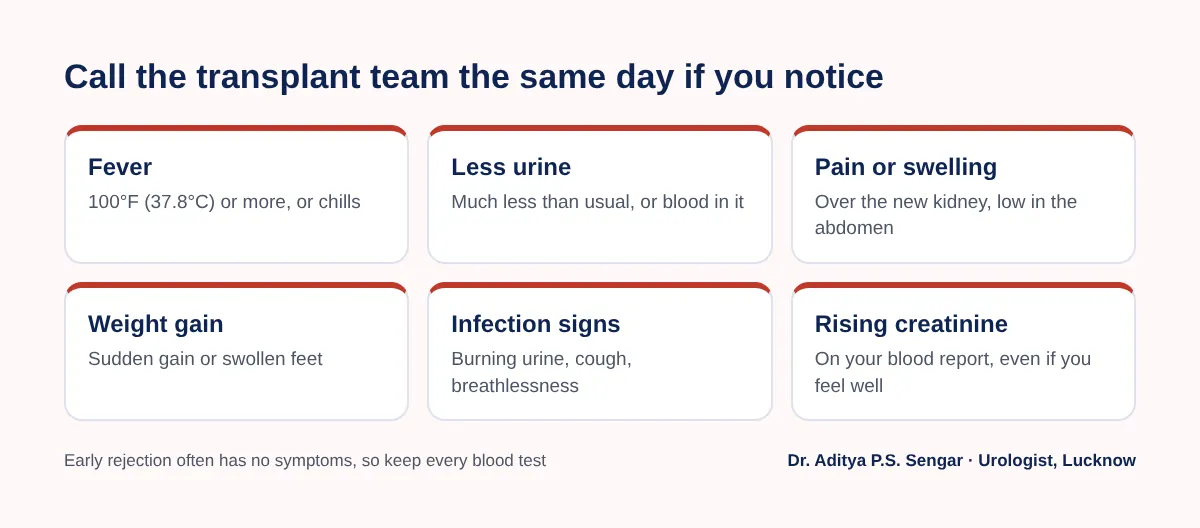
Warning signs: call the transplant team the same day
- Fever of 100°F (37.8°C) or more, or chills
- Much less urine than usual, or blood in the urine
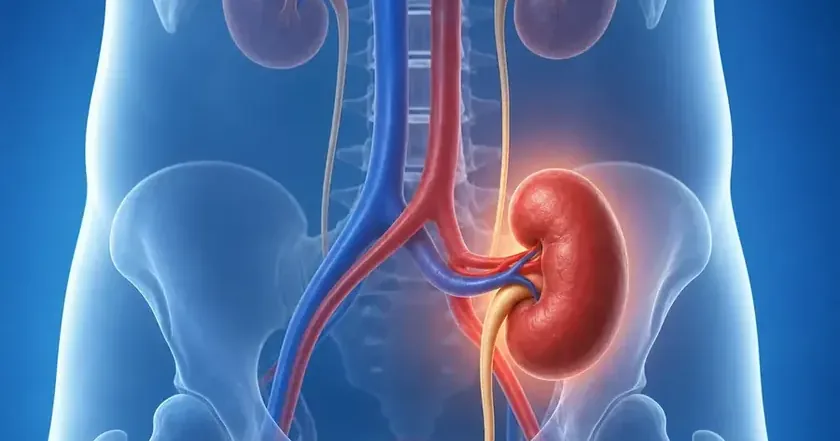
- Pain or swelling over the new kidney, which sits in the lower right or left side of the abdomen
- Sudden weight gain or swelling of the feet
- Burning when passing urine, cough, breathlessness, vomiting or loose motions that stop you taking your medicines
- A rise in creatinine on your report
Rejection often causes no symptoms at first and shows only on blood tests. That is why regular tests matter even when you feel well.
Diet after a transplant
- Eat home-cooked, balanced meals with enough protein, and keep salt low to help blood pressure.
- Limit sugar and fried food, because steroids and tacrolimus can raise blood sugar and weight.
- Avoid grapefruit and pomelo (chakotra) and their juices. They raise tacrolimus levels.
- Drink the amount of water your team advises. Most patients are asked to drink more than before.
Going back to work, driving and family life
- Office work: usually after about 2 to 3 months, once visits become less frequent.
- Driving: usually after about 4 to 6 weeks, when you can move freely without pain.
- Sexual activity can usually resume after about 4 to 6 weeks, once the wound has healed.
- Women who wish to become pregnant should plan it with the team, usually after the first year and when the kidney is stable, because some medicines must be changed first.
- Use sunscreen and get any new skin spot checked. Transplant medicines raise the risk of skin problems over the years.
Long-term follow-up
After the first year, most patients need a check-up and blood tests every 1 to 3 months for life. A well cared for kidney from a living donor commonly works for many years. Keeping every appointment, taking medicines on time and controlling blood pressure and sugar give it the longest life.
Frequently asked questions
How long does it take to recover from a kidney transplant?
Most patients go home in about 1 to 2 weeks and feel close to normal within 6 to 8 weeks. Office work usually starts again after about 2 to 3 months.
Do I have to take medicines for life after a kidney transplant?
Yes. Anti-rejection medicines are needed for as long as the transplanted kidney works. The doses are usually reduced over time, but they should never be stopped without the transplant team.
What are the signs of kidney rejection?
Fever, less urine, swelling, weight gain or pain over the new kidney can be signs, but early rejection often has no symptoms. A rise in blood creatinine is the most common early sign, which is why regular tests are important.
What should I avoid eating after a kidney transplant?
Avoid grapefruit and pomelo, raw or undercooked food, street food and unboiled water in the early months. Keep salt and sugar low.
When is the DJ stent removed after a kidney transplant?
It is usually removed a few weeks after surgery in a short day procedure. Your team will tell you the date.
Diagnosis and treatment: Kidney transplant in Lucknow · Send your report on WhatsApp for a free opinion
What to eat: free diet planner for kidney stones, prostate, urine infections and transplant
This guide gives general information and does not replace a consultation. In an emergency, go to the nearest hospital.
Book a consultation with Dr. Aditya P.S. Sengar
OPD Mon to Sat, 12:00 PM to 6:00 PM at Precision Urology Hospital. Book on WhatsApp and the team will confirm your time.
Send your report on WhatsApp for a free opinionPrecision Urology Hospital, 652B/37 Pratap Nagar, Tedhi Pulia Ring Road, Lucknow 226022. Get directions