Short answer
Most stones of 5 mm or smaller pass on their own within a few weeks, especially when they are in the lower ureter. Stones of 5 to 10 mm pass less often, and stones over 10 mm rarely pass without treatment. Fever with stone pain, pain that medicine does not control, or very little urine needs urgent care.
After an ultrasound or CT scan, the first question most patients ask is: "Will this stone pass by itself?" The answer depends mainly on the size of the stone, where it sits and whether it is blocking the kidney. This guide explains how to read the size on your report and when kidney stone treatment is needed. It is written by Dr. Aditya P.S. Sengar, urologist in Lucknow at Precision Urology Hospital.
Size: the most important number on the report
Stone size is written in millimetres (mm), often as two numbers such as "6 x 4 mm". The smaller width matters most, because that is what has to fit through the tube from the kidney to the bladder (the ureter).
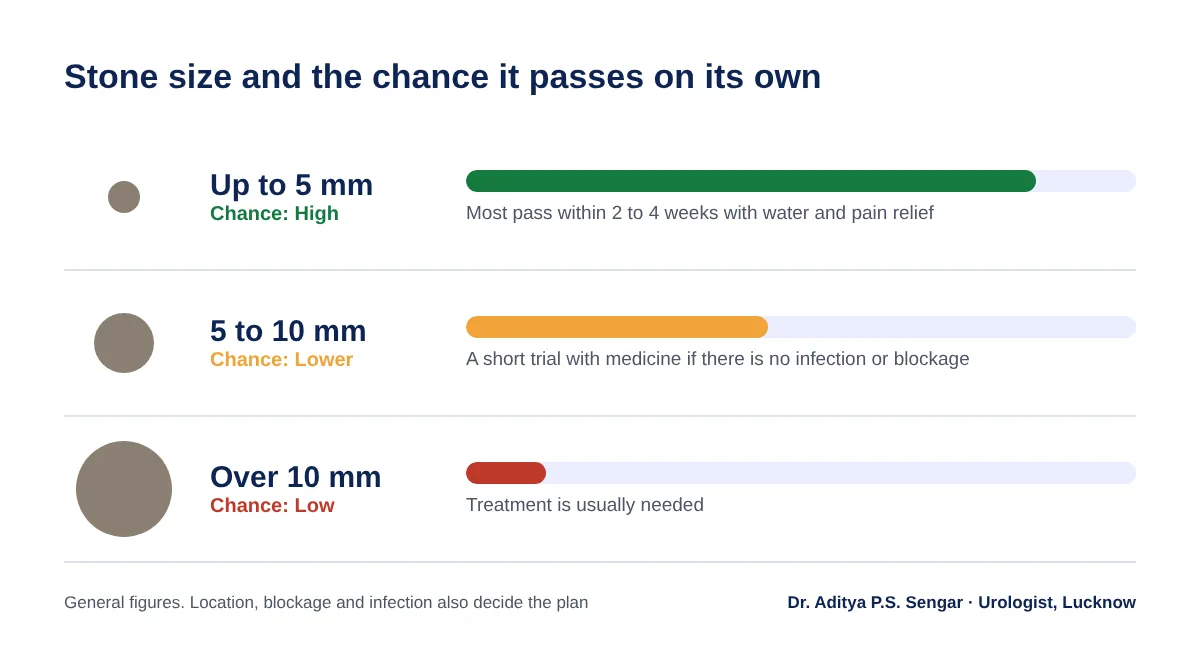
| Stone size | Chance of passing on its own | Usual plan |
|---|---|---|
| Up to 5 mm | High: most pass within 2 to 4 weeks | Water, pain relief, sometimes a medicine to relax the ureter |
| 5 to 10 mm | Lower, falls as the stone gets bigger | A short trial with medicine if there is no infection or blockage, otherwise treatment |
| Over 10 mm | Low | Treatment is usually needed |
These are general figures. Your urologist will look at the full picture before advising you.
Location matters too
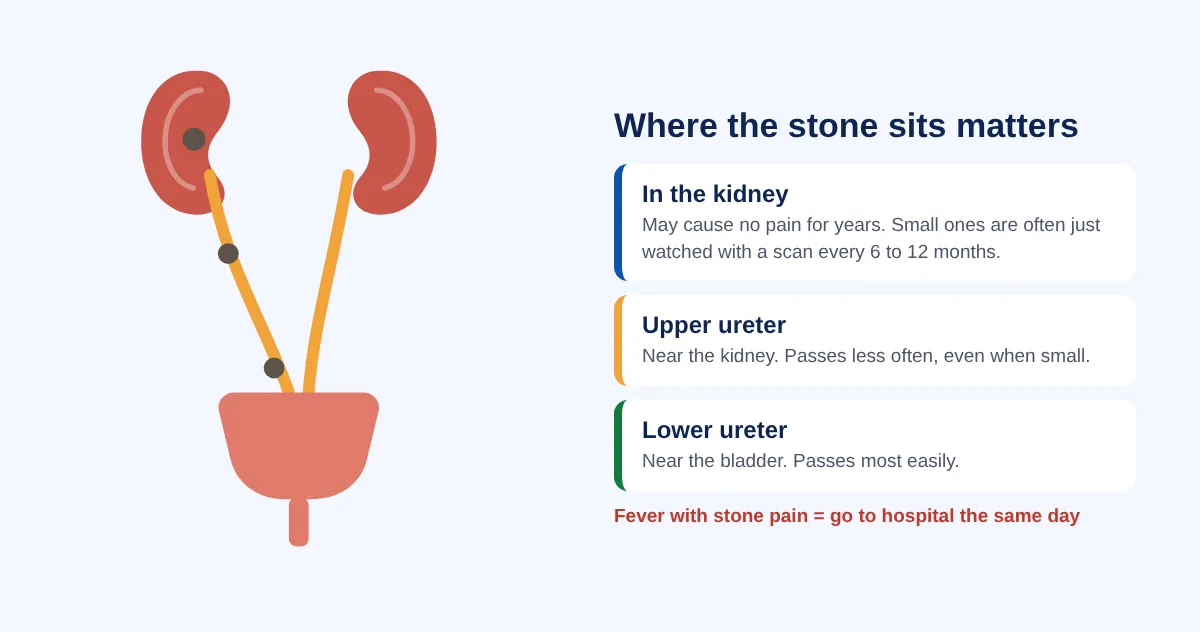
- Lower ureter (near the bladder): stones here pass most easily.
- Upper ureter (near the kidney): stones here pass less often, even when small. Read more about stones in the ureter.
- Inside the kidney: a small stone that is not blocking anything may cause no pain for years. It may only need watching with a scan every 6 to 12 months.
Other things your urologist looks at
- Swelling of the kidney (hydronephrosis). It means the stone is blocking urine flow. Mild swelling can be watched for a short time. Marked swelling needs earlier treatment.
- Kidney function. This is checked with a creatinine blood test.
- Signs of infection in urine or blood tests.
- One kidney only, pregnancy, or stones in both sides. These lower the threshold for treatment.
- Your pain and your work. Pilots, drivers and people who travel often may choose earlier treatment.
How long is it safe to wait?
If the pain is controlled, there is no infection and the kidney is working well, a stone can usually be given about 4 to 6 weeks to pass, with a repeat scan. A stone that blocks the kidney for longer than that can damage it, even if the pain has settled. Do not stop follow-up just because the pain has gone.
Helping a small stone pass
- Drink enough water to pass about 2.5 to 3 litres of urine a day, unless your doctor has told you to limit fluids.
- Take the pain medicine prescribed. A medicine such as tamsulosin may be given to relax the ureter.
- Stay active. Walking is fine.
- Pass urine through a strainer or cloth to catch the stone, and bring it to the clinic for testing. Knowing what it is made of helps prevent the next one.
Warning signs: see a doctor the same day
- Fever or chills with stone pain. An infected, blocked kidney is an emergency and needs drainage quickly.
- Pain that does not settle with the prescribed medicine, or repeated vomiting
- Very little or no urine
- A stone in a single kidney
When a stone does not pass
If a stone is too large, is not moving or is causing blockage or infection, it is removed with minimally invasive methods. These include shock-wave treatment from outside the body, a thin telescope passed through the urine passage with laser fragmentation, or keyhole surgery for large kidney stones. None of them need a big cut. Read about endourological surgery, or send your scan report on WhatsApp for a free first opinion.
Frequently asked questions
Can a 6 mm kidney stone pass naturally?
Yes, many 6 mm stones pass, especially from the lower ureter, but the chance is lower than for stones under 5 mm. A trial of 4 to 6 weeks with medicine is often tried if there is no infection or marked blockage.
Will a 10 mm stone pass on its own?
It is uncommon. Most stones of 10 mm or more need treatment, particularly if they are in the upper ureter or blocking the kidney.
How long does a kidney stone take to pass?
Small stones often pass within 1 to 4 weeks. If a stone has not passed in about 4 to 6 weeks, a urologist should review the plan.
Is CT scan better than ultrasound for kidney stones?
A plain CT scan (CT KUB) shows the exact size and position of a stone, including stones in the ureter that ultrasound can miss. Ultrasound has no radiation and is used for follow-up and in pregnancy.
Does drinking a lot of water help a stone pass?
Drinking enough water to keep urine pale helps small stones move and prevents new stones. Drinking very large amounts suddenly does not push out a large stone and can increase pain.
Diagnosis and treatment: Kidney stones in Lucknow · Send your report on WhatsApp for a free opinion
Keep a record: free kidney stone and recovery tracker with a stent reminder
What to eat: free diet planner for kidney stones, prostate, urine infections and transplant
This guide gives general information and does not replace a consultation. In an emergency, go to the nearest hospital.
Book a consultation with Dr. Aditya P.S. Sengar
OPD Mon to Sat, 12:00 PM to 6:00 PM at Precision Urology Hospital. Book on WhatsApp and the team will confirm your time.
Send your report on WhatsApp for a free opinionPrecision Urology Hospital, 652B/37 Pratap Nagar, Tedhi Pulia Ring Road, Lucknow 226022. Get directions